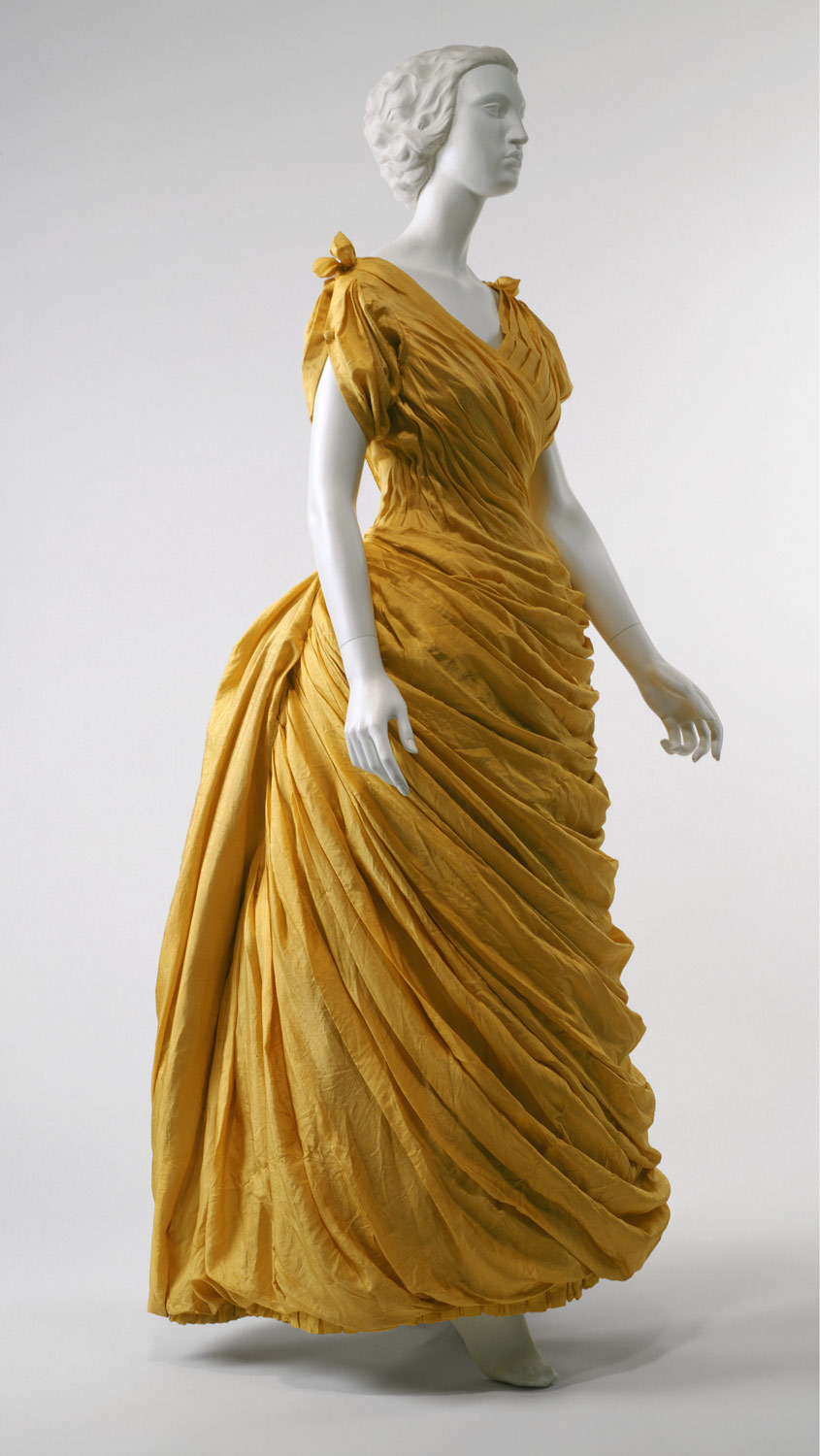
Monday, 2 December 2013

Eileen, Technical session


Sample bodice
Don't forget that we're doing period "overlocked" darts, meaning that the darts are getting sliced open and the seam allowance is going to be scalloped and then wipe stitched around the edges

The rest of the seams on the bodice can be overlocked by machine

-Cut out lining and sew back panels together, then sew front panels together DO NOT attach panels at side seams

-we'll be using millinery peter-shim (as it is firm and can be ironed into a curve) to go along the inside front edge as a facing. This will add reinforcement 
-Machine sew petershim on first, then iron into curve

FOR NEXT WEEK
-get lining ready
-machine sleeve together
-draft cuff and cut out
-bring decorations
-note the sleeve will need darts in at the elbow
-clip at any pulling points
-line cuff with stiffener 

Technical session with Eileen

-Cut and tack sleeves
-Tack outside the seam lines and make sure to make tacking lines cross at corners.
-Tack all pieces
-Tack all darts in
-Machine bodice pieces together (Note: waist tack line doesn't match up at side seam)
-cut darts open nearly to the top, then insert a large needle into the last point of the dart.
-Iron the dart out, using the needle at the tip to help to flatten it.
-Clip into darts evenly on the edges
-scallop edges
-whip stitch over scallops


think about decoration for next time

Friday, 29 November 2013

Dye room day

Dying my top fabric for the top coat today,  excited and nervous about it.

formula for dying with Dyrect dye (assuming we are dying 100grams of fabric)

Density       Dye                     gm of salt
Pale             0.1-0.2gms         5gm
Med            0.2-0.5gms         10gm
Heavy         1.0-2.0                20gm

My fabric weighs ~250gms so a total of 5tsps of dye is to be used
I'll prepare 2.5 tsp of bottle green and 2.5 of royal blue, but will only use about 1.5 of each at first then add more if I need to darken it.

So now I'll,
-heat the water
-wet the fabric
-mix the dye
-add ~3/4 of my dye to the dye vat and sample. If sample is to light I'll add more of my dye mix, if it is to dark then I'll drain some of the water and then add more water to thin it out.

First Attempt: Mixed 2.5 tsp of each and then added 3/4 of all dye, seemed to be to dark so I emptied out 1/2 the water in the dye vat and refilled it to dilute the dye

Second attempt: Went great! I matched it spot on and then whilst moving my fabric I bumped something and spilled the remainder of the green dye in my vat! BAH!!!!!!

Third attempt: Finally got it, third time the charm :P


I just want to be taught...

I have been sooooo frusterted as of late, first I don't feel like the tutors have prepared us for our last year, secondly I feel like we have very little support and then are reprimanded for doing things inncorrectly. It's so disheartening I cane here so eager thinking that I would be taught so much and have so many opportunities and yet I feel like  it's all fallen short. For example when we had our tailoring class it was incredibly fast paced so we never had time to fully learn the skills, take in the process and develop any sort of proficient skill sets, not t mention the fact that there where nearly 30 students to one tutor. When ever this is brought up to the tutors simply relpy with "well in the real work you won't have much time t do things" but they're looking over the fact that in the real world the people doing these thing would have had to train and refine their skills. We're expected to do it in real time, whilst learning new skills, and researching and goodness knows whatever else. I'd also like to touch on the fact that we rarely have any sort of back ground lecture on the time period or subject that we're studying, I understand that we're supposed to learn how to use the Internet and our researching skills but I'd like to point out that so much information out there isn't correct, so now we have miss informed ideas and have learned things incorrectly.

Wednesday, 20 November 2013

Day 'off'


Today was a nice ‘day off’, spent my day working on my sample bodice and researching for my Everyday Lives costume (an aesthetic period dress), as well as having my tutorial with Elizabeth.
Fairly productive with my sample bodice today, put my sleeves together which turned out lovely (insert picture here). I also added a bit more to the front as I am altering it to fit me J I’m quite excited as I have enough fabric left over to make myself a matching pencil skirt, I’m going to try to add a few bits and bobs to make it have a bit of a Victorian feel.
Research included a lot of google searching images, I haven’t been able to find quite what I’d like to do, but it certainly gave me some ideas and got the creative juices flowing. I’m going to be looking into a particular painter by the name of Whistler, Elizabeth said she actually has a book of his paintings called Whistler’s Women so that should be quite helpful.
The tutorial was short and sweet, just a bit of a check in. I let Elizabeth know about my stress towards the tailoring aspect of my costume, and we talked about how I need to be more assertive with tracking Glenda down and asking questions. I’m thinking one of the things that may help me is getting all the information, looking at the ‘big picture’ if you will, so I understand why we do all the little bits and pieces and how they work together to create the final piece. She seemed to like the idea of me doing an Aesthetic Movement dress, and agreed that my final costume should be corseted and structured so that I have a nice well rounded portfolio for the end of the year show. She suggested something from the 17 century, but I’m not to sure about that. I’m thought it would be really neat to do a ‘Gibson Girl’, but we’ll see how Elizabeth feels about that, I would like to do something a bit later, t

Monday, 18 November 2013

Researching for ordinary lives

Doing some research for Ordinary lives, I REALLY want to do an Aesthetic dress :) here are some I've found ....
The design house Liberty & Company was known for its "artistic" dresses, with romantic and artisanal medieval effects, or faintly exotic and orientalizing motifs and silhouettes. This evening dress is particularly rare and unusual in that it fully incorporates what were viewed as classical elements of the period. The asymmetrical bodice with chiton sleeves alludes to the wearing of a himation anchored at one shoulder. Likewise, the two bowknots replace the fibulae that would have held together an ancient peplos. But the strongest classicizing detail of the gown is in its densely gathered silk, a technique that conjures the wet-drapery of classical statuary. While the gown's internal structure, with a wasp-waisted corset and bell-shaped underskirt, conforms to the fashionable hourglass silhouette of the period, its surface is intended to replicate the articulated folds that characterize classical renderings of drapery. This softly gathered surface would also have conveyed a tantalizing "naturalism." The consequence is an impression of the female body as less confined by the rectitude of a precise and controlled tailoring.


http://www.metmuseum.org/toah/works-of-art/1985.155


Here are some pretty good articles as well,
http://hubpages.com/hub/FashionsofTheAestheticMovementACultofBeautyandVictorianCounterculture

http://cai.ucdavis.edu/waters-sites/aesthetic_movement/aesthetic_movement.html


The Eve of Saint Agnes

1863
Oil on canvas
117.8 x 154.3 cm
Purchased by HM Queen Elizabeth The Queen Mother

The Eve of St Agnes had been the subject of poems by both John Keats (1819) and Alfred, Lord Tennyson (1837), and these works inspired a number of drawings and paintings by Millais. This painting is based on a stanza from Keats’s poem. Keats based his poem on the superstition that a girl could see her future husband in a dream if she performed certain rites on 20 January, the evening before the feast day of St Agnes. St Agnes was a young Roman girl, martyred in the fourth century for her faith. Keats’s protagonist, Madeline, is unaware that her lover, Porphyro, is hidden in the room. Later the poem tells how Porphyro wakes Madeline and they daringly elope on the following day. Millais was inspired by the descriptive and evocative language of Keats’s poem. In the painting, the artist expresses the tension between romantic and sensual love, suspending Madeline in a pool of blue-green moonlight at the foot of her bed in anticipation of her vision.
Millais worked at night in the King’s Room at Knole in Kent to create a moonlit interior for Madeline, from Keats’s The Eve of St Agnes (1819). His model for Madeline was his first wife Effie. Her detailed jewel-like dress contrasts with the rapid brush-work elsewhere in the picture. Millais spent three and a half days at Knole and completed the picture in his London studio.

More found info
Aesthetic Dress:
Aesthetic dress of the late 19th century is sometimes also referred to as artistic dress. However, the term "artistic" tends to imply this fashion trend was limited only to those in the creative circles. While the fashion movement did get its origins amongst the artists of the period, aesthetic dress did spill over into mainstream fashion. Dresses were typically made of cotton, linen, velvet, wool, or oriental silk. They were slightly gathered at the waistline, had large puffed sleeves, long draping skirts, and often had a watteau back (a drape of fabric attached at the back of the neckline which falls to the floor). Favorite colors were lemon, green, cream, light brown, salmon-pink, deep purple, and other soft colors derived from natural dyes. The aesthetic dress movement lasted well into the early 20th century.


Thursday, 14 November 2013

Long (unproductive) Week


It's been a bit of a long and frustrating week, and i can't believe how quickly it's gone by.  I think it's partially because I've been quite under the weather this week, ended up staying in bed all of Wednesday to try and get well enough to last through the rest of of the week/weekend. Today however was productive in one way or another, though I may not have gotten a lot done I now know what I need to do in order to keep moving forward and be ready for the fitting on the 28th. 
Been playing with shapes for the top coat collar and I think it's finally on the right track


Really glad I got in some time with Naomi today to finally clarify some thing so that I can really move forward, now it's just getting from point a to point b.